
Robots can do kung fu flips. So when will they clean my house?
September 30, 2026
By Matthew Pietz
This article was written and edited without the use of AI.
You may have seen the jaw-dropping acrobatics of Chinese-made Unitree robots at a festival in February. That same month, US manufacturer Boston Dynamics put out yet another clip of android agility.
All very impressive, but a common refrain we hear when talking with people about the future of robotics is, “Let me know when they can fold laundry.”
So, when will that be?
Headline up front: Probably about five years.
And yet robot housekeepers are already available for pre-order. How can that be? It’s a fundraising ploy. Humanoid robots are not ready to ship to your home, and the claims that they will be autonomous “in 2026”, as 1X says, are highly spurious. In the meantime, the devices, which cost about $20,000, are remote-controlled by humans and despite that, extraordinarily slow.
But isn’t picking up socks easier than doing a backflip? The critical difference is that the robots you see doing gymnastics are following a program, not reacting in real time to their environment, which is much harder.
Another misleading fact in the robot hype cycle is the rapid acceleration in manufacturing. It’s true that shipments of humanoid robots jumped tenfold from 2024 to 2025, and look set to double again in 2026:
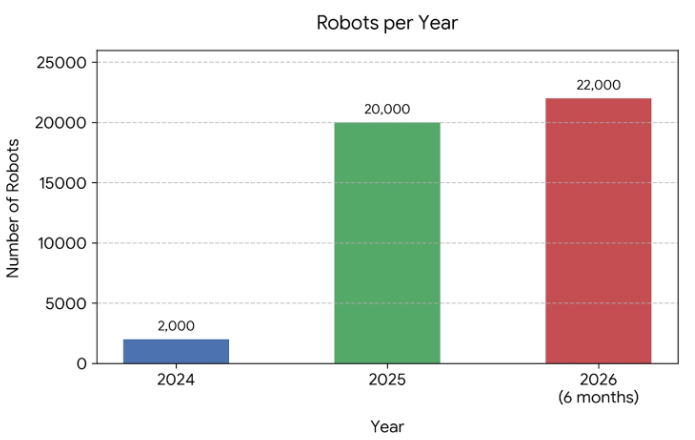
Source: Counterpoint Research
What this data doesn’t show is the use of these robots. Between 60% and 80% are bought by researchers or other robot makers. Another percentage are bought for fun by people who want to be early adopters or show off a robot to friends. Probably around 10% of these machines, or about 2,000 worldwide, are actually given any work to do.
Even if and when they can think and react to a home environment—like this Unitree robot apparently can, in a video released this month—your home will be one of the last places humanoid robots arrive.
They’ll be in factories first, because they are highly controlled environments: no stairs, no pets or children, no surprises. Their first work with people may be doing clean up or fetching supplies in shops, then eventually in nursing homes or hospitals, again with rigid routines and surrounded by human workers who can step in.
Our homes vary tremendously in their layout, contents, and occupants, and no paid minders will be there, so the robots have to be absolutely safe and have minimal glitches before they are sold as housekeepers.
Projections from industry experts as to when that might be tend to hover around 2031-2035, and the price is expected to be $5,000-$10,000 (though Tesla says Optimus will be ten times that).
Of course, imagining a mechanical helper brings some people as much anxiety as joy. What kinds of regulations will we need to ensure the robots among us pose no danger? What would it take to feel comfortable with an android pottering about the house? Five years might feel like a long time to answer these questions, but to get effective and comprehensive safety laws passed, it’s only just enough. Let us know in the comments how you feel about robots in the home!
Click here to subscribe and be notified of future posts.
Cover photo by Rajesh Rajput on Unsplash
