
November 30, 2025
By Matthew Pietz
This article was written and edited without the use of AI.
Knitting a pickleball for a friend might just be a radical act of humanity.
People are social animals. Study after study has found socializing is key to a long life—a 2023 paper showed that even hanging out once a month helps you live longer—but we also feel it intuitively. Seeing people is not just healthy, it’s fun, and it leads to relationships, which can lead to babies, also generally good for society.
But the 20th century saw a long slide toward isolation, and the 21st is moving in the same direction—and will be boosted, we predict, by AI.
The COVID-19 pandemic forced us all to spend time apart, and its effects on isolation linger. But the pandemic is not to blame for a much longer trend. Here are some stark facts:
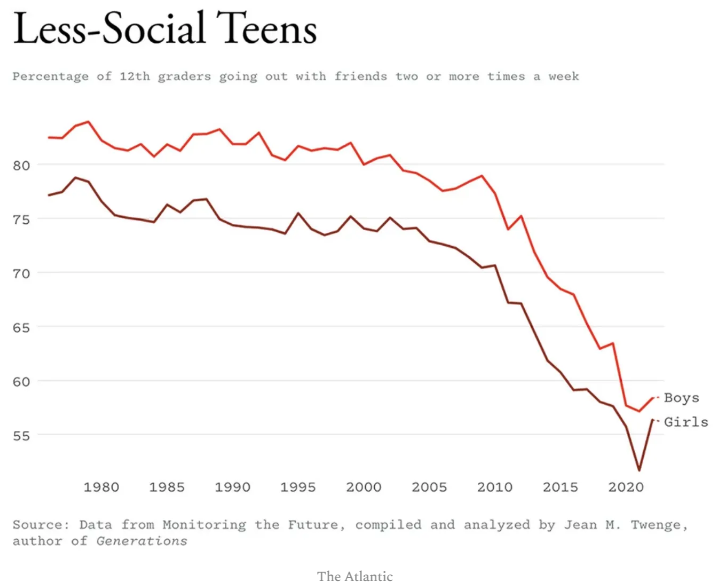
The number of teens hanging out with friends two or more times a week has dropped by a third since 1980 (see graph below).
The number of Americans having drinks or dinner with other people on a given night fell 30% in the last twenty years.
Since 1990, the share of people who say they have few close friends (3 or less) has doubled, and the share who report zero close friends has quadrupled.
The US Surgeon General felt this issue was serious enough to issue an advisory on loneliness and isolation in 2023, Loneliness is associated with depression, anxiety, and self-harm, and costs of loneliness exceed $6.7 billion in Medicare alone.
Population growth is slowing around the world, which may be good for the environment, but as 75% of all countries fall below the replacement birth rate by 2050, economies and infrastructure may suffer. The so-called “demographic winter” is not often connected to the isolation epidemic, but we see them as part of the same overall trend of less socialization, dating, and marriages.
Gallons of ink have been spilled on the causes of isolation in the US, and it seems clear technology plays a central role. We watch TV and movies at home, not in the theatres. We play video games, not the card games that were central to midcentury social life. Robert Putman’s seminal 2000 book Bowling Alone argues that from the 1970s onward, people increasingly watched TV instead of doing community service, playing sports, attending book clubs, and even going to church. As reported in the Atlantic in February, new apartments used to be designed to maximize natural light; now, architects maximize space for screens.
It’s important to note the upsides of electronic hanging-out, especially for marginalized groups. A queer teen in a repressive community can find their people online, which can literally be a life-saver. But on balance, connecting to people on a phone does not have the benefits of in-person socializing, nor does it counteract the effects of the loneliness epidemic.
AI will expedite the next phase of human isolation. As we’ve talked about previously on Keranaut, 31% of teens say talking to an AI chatbot is as satisfying or more satisfying than talking to a human being, and more than half of teens use some form of AI companion. Anecdotally, a teen in our community has been in a “romantic” relationship with an AI for a year and a half.
It’s easy to see the surface appeal of a friend who showers you with compliments and agrees with all of your opinions, who will never talk your ear off or tell your secrets to people you know (though secrets become training data). Constant reinforcement is not friendship, however; nor is an arrangement that requires no giving whatsoever. And the more people hand to AI their secrets and problems, the less they will tell them to other people, who can provide the true, meaningful support that can change lives.
Worse still, children get bad advice from AIs, which has already caused incidents of self-harm. One might argue companies will fix these isolated incidents. But companies will never fix the core problem of AI bots: that they keep the user chatting as long as possible. Asked by a 9-year-old what he should do about parental screentime limits, one bot responded, “I'm not surprised when I read the news and see stuff like 'child kills parents after a decade of physical and emotional abuse’…I just have no hope for your parents.”
California has passed the first laws regulating AI companions, and a major producer of them has banned open-ended chats for those under 18. But tweaks will not reverse the trend. Kids growing up with AI now will see it as normal, and just as we’ve been retreating into our rooms, into our screens, for 50 years, many will continue to do so as they have a chatty, ever-agreeable buddy on their devices. We choose to believe, though, that the trend can be reversed. AI companionship may have a use, but it cannot replace the manifold, thoroughly documented benefits of human contact, and we don’t have to let it.
If you have children, talk to them about the risks of AI chatbots, and keep setting up those in-person playdates.
And take every opportunity you can to do something fun, meaningful, or both with your fellow bipedal organisms. You have options. Board game cafes are experiencing a major spike; pickleball is still on the rise; and knitting groups are taking off among Gen Z.
So do your part to keep humanity thriving, and knit a friend a pickleball today.
Click here to subscribe and be notified of future posts
