
China’s new 5-Year Plan could carry them to global first place
April 29, 2026
By Matthew Pietz
This article was written and edited without the use of AI.
“Who owns the robots rules the world,” argued Harvard economist Richard Freeman in his famous 2015 article. Beijing, no doubt, hopes he was right.
People love to predict that America is about to be eclipsed. In the 1950s, US politicians hollered that Communism was poised to swallow the planet. In the 1980s, the economic dominance of Japan looked so likely that middle managers everywhere took Japanese lessons. And today, pundits compare America’s failing leadership and pointless wars to China’s long-range planning and steady ascendancy, and say the ascendancy of Beijing is inevitable.
Empires die hard, America included. But at Keranaut we think predictions of China preeminence are credible, because control of tech—robots, not least—will determine the winner of the next power struggle, and China is primed to win at tech.
China’s Five Year Plan for 2026-2030, released in March, points the way. They prioritize excelling at “quantum technology, biomanufacturing, hydrogen and nuclear fusion power, brain-computer interfaces, [and] embodied artificial intelligence.” How? They’ll improve tech education, simplify immigration for tech experts, and ease regulation on tech companies. And the entire Five Year Plan hinges on China’s solution to basically everything: build, build, build. This is precisely where they can lap the US.
Dan Wang’s 2025 book Breakneck persuasively argues that China is a nation led by engineers, whereas the US is led by lawyers, with concrete effects. Wang points out that California and Beijing started discussing high-speed trains around the same time. Thirty years on, China has built 28,000 miles of track. A California project, approved but then hampered by litigation, plans to lay its first miles of track in 2030…at the earliest.
When China’s government threw its tremendous weight into producing electric cars, many observers doubted (including Elon Musk in 2011) they could engineer quality autos. They were wrong, and we’ve spoken to a strategist at a major US automaker who feels at this point, China can never be outdone in electric vehicles.
They can do the same with robots.
China dominates not just manufacturing of robots that walk and work (see below) but they also control 60% of the supply chain.
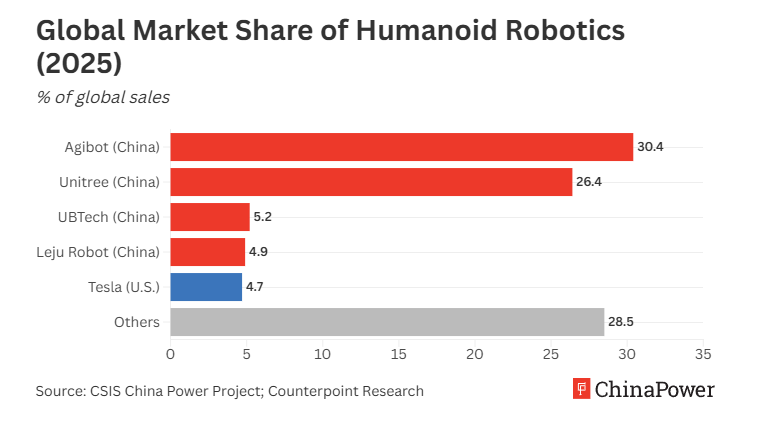
For decades, China’s gamble has been to put everything into state-led manufacturing, and figure out demand later. It isn’t evident they’ve won that gamble yet, but it has led them through 40 years of growth, and demand for robots will be massive. The US is far better at producing unicorns and innovators, and Boston Dynamics and Tesla are breaking ground in highly specialized tasks. But China is going to crank out affordable, simple robots that can get many jobs done. And in an economy evolving at blinding speed, as the tech economy will do, whoever leaps ahead early will have a massive advantage.
Harvard’s Dr Freeman was talking about “ruling the world” in purely economic terms, but there are also a surveillance and military implications here. Videos released by Beijing show they are engineering killer bots and proud of it (the US is no doubt doing the same, but more quietly), but the real threat may be the everyday machines. China has installed spyware in consumer electronics many times in the past. It is not a stretch to imagine a backdoor in Chinese robots giving Beijing some type of access to the androids they are turning out. If there is no low-cost competitor to Chinese manufacturers, in 5-10 years we may see millions of Chinese bots in factories, businesses and homes.
Let’s hope that, if Freeman is right, the ownership of the robots is not dominated by any one country, or company, but that other manufacturers and nations catch up to ensure a more level distribution of global power.
Click here to subscribe and be notified of future posts.
